Three terms, three different jobs, and most stalled SEO is just effort poured into the wrong one.
On-page SEO is only one of three layers, and the difference between them is simple: on-page controls whether you are relevant, off-page controls whether Google trusts you, and technical controls whether Google can read you at all. Here is how all three differ, the order to fix them in, and when to bring in professional SEO services to run them together.
01 / What on-page SEO is, in 30 seconds
In one breath
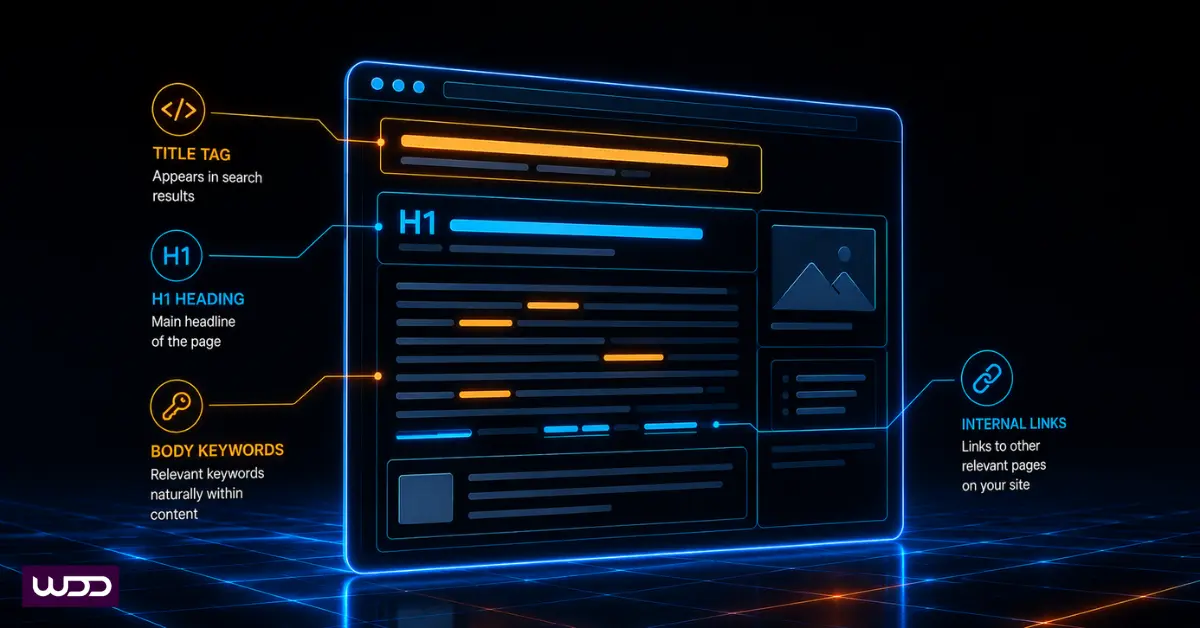
On-page SEO is the practice of optimising everything on a page itself, the content, title tag, headings, keywords, internal links, images and URL, so search engines and AI systems understand what the page is about and rank or cite it for the right query.
It is the one layer you control completely, which makes it the fastest place to win. Off-page SEO (backlinks, mentions) and technical SEO (crawling, speed) matter too, but on-page work is where most stalled rankings are actually fixed.
The rest of this guide is a plain-English, do-it-today on-page checklist: what each element is, how to get it right, and how to tell it is working.
Here is the trap we see most often. A Petaling Jaya manufacturer we audited had paid RM18,000 over a year for backlinks, while the product page those links pointed at carried a vague title, no clear H1 and content that never matched what people actually searched. The money went to the hardest, slowest layer while the cheapest, fastest one, on-page work, sat untouched. On-page is almost always where the quick wins hide.
What Experience Teaches Us
Most Malaysian sites are not losing to competitors. They are losing to their own fixable on-page work.
After years of audits, the pattern is consistent: businesses reach for backlinks and paid ads while the cheapest, fastest wins sit untouched on their own pages. Vague titles, one intent in the heading and another in the body, missing alt text, three H1s on a page. On-page SEO is the only layer you control completely, and it is almost always where the quickest ranking movement hides.
Our honest advice: before you spend a ringgit on links, make sure the page is crawlable and the on-page signals are clean. Authority is worth paying for only once there is a relevant, indexable page for it to lift.
02 / Master the levers you fully control
What is on-page SEO?
On-page SEO is the practice of optimising the content and HTML of a page so it is relevant, clear and easy for search engines, AI systems and users to understand. It is the only layer you control 100%, which is why it is usually the fastest to improve and the best place to start.
Every on-page decision answers one question for Google: what is this page about, and who is it for? Off-page SEO (backlinks and mentions) and technical SEO (crawling and speed) are the other two layers, and we cover how they fit together further down. But the elements below are the ones that live on the page itself, the ones you can edit today without waiting on anyone else.
03 / Work through the on-page SEO checklist
The on-page SEO checklist
These are the on-page elements that decide whether a page ranks, in the order most audits should work through them. Tap any item for what it means and the one action to take today.
Before a single word, decide what the searcher actually wants and match the page format to it. A "how to" query wants steps, a "best" query wants a comparison, a "what is" query wants a definition first. Intent mismatch is the most common reason a keyword-rich page still does not rank. Do this: search your target keyword, look at what already ranks, and make sure your page delivers the same job better, not a different one.
The title tag is both a ranking signal and the single biggest influence on whether people click your result. Put the primary keyword near the front, keep it under about 60 characters so it does not truncate, and write it for a human, not a keyword stuffer. Do this: lead the title with your keyword, add a reason to click (a number, a year, a benefit), and check it is unique across your site.
The meta description does not directly rank you, but it is your ad copy in the results and it lifts click-through when it is written well. Keep it to 150 to 160 characters, include the keyword in the first sentence, and give a concrete reason to click. Do this: summarise what the page delivers and end with a soft prompt, then confirm it is not being auto-truncated on mobile.
Google no longer rewards repeating one exact phrase. It rewards covering the topic and its related terms the way a real expert would. Use your primary keyword in the title, the H1, the first 100 words and one subheading, then write naturally with the synonyms and related concepts the topic needs. Do this: place the keyword in the key spots once each, then stop counting and write for completeness instead.
One H1 that states the page topic, then a clean H2 and H3 hierarchy that breaks the topic into sub-questions. Clear structure helps readers scan, and it helps Google and AI systems lift the right section as a direct answer. Do this: make sure there is exactly one H1, phrase key H2s as the questions people ask, and never skip a level for styling.
Depth is not word count, it is completeness: does the page resolve the question so the reader never needs a second search? Show real experience, expertise, authority and trust (E-E-A-T) with specifics, examples, author credentials and sources. Do this: list every sub-question a searcher might have on this topic and make sure the page answers each one, with a named author and honest detail.
Internal links connect related pages so readers and Google can navigate the topic, and they pass ranking strength to the pages that matter. Use descriptive anchor text, not "click here". Do this: add two or three links to closely related pages using keyword-relevant anchors, and see our internal linking strategies for the full method.
Descriptive file names and alt attributes tell Google what an image shows, carry relevance, and serve image search, while compression keeps images from dragging page speed. Do this: rename files before upload (on-page-seo-checklist.webp, not IMG_2043.jpg), write alt text that describes the image, and export to WebP at a sensible size.
A short, readable, keyword-relevant URL tells a person and a crawler what the page is about before they open it. Avoid dates, parameters and random strings. Do this: keep the slug to a few words including the keyword, and if you must change a live URL, 301-redirect the old one so you keep its ranking.
Impact labels are a general guide; the on-page elements that move your rankings most are whichever are currently weakest on your page.
Work top to bottom and you fix the highest-impact elements first. Most mysterious ranking swings trace back to the first few: a page whose title, H1 and body all point at slightly different intents.
04 / Score your on-page SEO in a minute
Score your on-page SEO
Tick every on-page element your target page already gets right. The score updates live and tells you where you stand.
0 of 10. Tick the elements your page already gets right to see your score.
A quick self-check, not a full audit. A live page can still be held back by off-page or technical issues the checklist above does not cover.
05 / Win the AI answer, not just the blue link
On-page SEO for AI and LLM search
The same on-page work that helps Google rank you now also decides whether ChatGPT, Google's AI Overviews, Gemini and Perplexity quote you. These tools pull answers from pages that are clearly structured and easy for a machine to read, so on-page work in 2026 is as much about being cited as being ranked.
Three on-page habits do most of the work here:
Name things plainly and consistently, the topic, your brand, the places and products, so an AI system can tell exactly what the page is about and who is behind it. Vague, pronoun-heavy writing is hard for a machine to attribute. Do this: state the subject in the first sentence of each section and repeat proper names instead of "it" or "they".
Lead each section with a direct, self-contained answer of about 40 words, then expand. AI systems lift these clean, quotable blocks straight into their responses. A question-phrased H2 followed by a crisp answer is the most citable shape there is. Do this: put the answer in the first two sentences under each heading, before the background.
Clear headings, short paragraphs, tables for comparisons, and structured data (schema) all make content easier to parse and quote. FAQ and Article schema in particular help both Google rich results and AI extraction. Do this: add the schema type that fits the page and keep formatting clean; the deeper markup work sits in technical SEO.
06 / See where on-page fits with the other two layers
How on-page SEO fits with off-page and technical SEO
On-page SEO is one of three layers, and it does not work alone. Technical SEO makes a page reachable and fast, on-page SEO makes it relevant, and off-page SEO makes it trusted. A useful way to picture it: technical opens the door, on-page furnishes the room, off-page is the reputation that fills it with people.
On-Page SEO
Off-Page SEO
Technical SEO
Controls
Relevance
Authority & trust
Crawlability & indexing
Where
On your page
Off your site
Site infrastructure
Main levers
Content, headings, keywords, internal links
Backlinks, mentions, reviews, PR
Speed, sitemaps, schema, mobile
Who controls it
You, fully
Mostly others
You / your developer
Speed to move
Fast
Slow
Fast once fixed
The order to fix them in is usually technical first (so pages can be crawled and indexed), then on-page SEO (so each page is relevant), then off-page (to build authority). For the full breakdown of the foundation layer, see our guide to technical SEO; for the complete picture across all three, our plain-English SEO guide ties them together. When the work outgrows what you can run in-house, professional SEO services bring all three together as one programme.
07 / Know whether your on-page SEO is working
How to measure on-page SEO
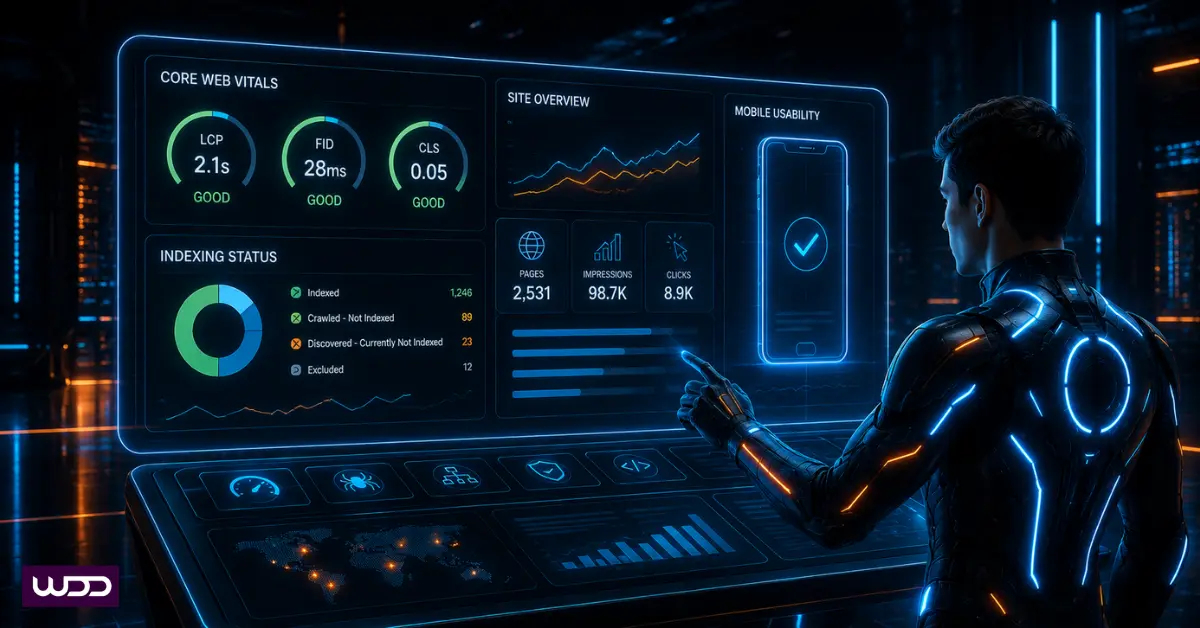
Measure on-page SEO in Google Search Console: watch impressions and average position for the page's target query. On-page work controls relevance, so its signal is whether Google is starting to show the page for the right searches, and then where it ranks.
The quickest read on whether an on-page change worked is the Search Console symptom your page shows. Use the check below to turn what you are seeing into the next move.
What is your page doing in Search Console?
Pick the line that matches your target page:
Pick what matches your page and we will name what to work on next, and the metric that will tell you it is fixed.
Rule of thumb: not indexed is a technical problem, flat impressions is an on-page relevance gap, and a stuck position with rising impressions is an off-page authority gap. Measure on-page work by impressions and position, off-page by referring domains, technical by the indexing and Core Web Vitals reports.
Not sure which layer is holding your rankings back?
Diagnose
SEO Audit & Strategy
Full technical, on-page and off-page audit, fixed in the right order. No buying links for pages Google can't read.
Prefer to talk it through first? Request a quotation and we'll tell you honestly which layer to spend on, even if it's the cheap fix.
08 / Clear up the questions everyone asks
Frequently asked questions
What is on-page SEO?
On-page SEO is the practice of optimising the content and HTML of an individual page, the title tag, headings, keywords, content, internal links, images and URL, so search engines and AI systems understand what the page is about and rank or cite it for the right query. It is the one layer of SEO you control completely.
How do I do on-page SEO?
Work through the on-page elements in order: match search intent, write a keyword-led title tag and meta description, use one clear H1 with a clean heading structure, place keywords naturally, build genuine content depth, add internal links, optimise images and alt text, and keep the URL short and readable. Fix the highest-impact items first, intent, title and content depth, then the quick wins.
What are the most important on-page SEO factors?
The highest-impact on-page factors are search-intent match, the title tag, and content depth and quality (E-E-A-T). These decide whether Google sees the page as the right, most complete answer to the query. Headings, keyword placement, internal links, images and URLs are important supporting factors, but they rarely rank a page that misses intent or lacks depth.
How long does on-page SEO take to work?
On-page work is the fastest layer to show movement, but it is not instant. Once Google recrawls the page, usually days to a few weeks, you often see impressions rise first, then position improve. A page that was already indexed can move within a couple of weeks; a brand-new page takes longer while Google establishes it. Off-page authority then decides how high it ultimately climbs.
What is the difference between on-page and off-page SEO?
On-page SEO is everything on the page itself, content, headings, keywords and internal links, and it controls relevance. Off-page SEO is everything done away from your site, mainly backlinks, mentions and reviews, and it controls authority and trust. You need on-page relevance before off-page authority has anything worth ranking, and technical SEO underneath both so Google can crawl the page at all.
Does on-page SEO help with AI Overviews and LLM search?
Yes. AI Overviews and large language models pull answers from pages that are clearly structured and easy to read. Answer-first sections, clear entities, clean headings and structured data, all on-page practices, increase the chance your content is quoted in AI-generated results, not just ranked in traditional search.
09 / Walk away knowing your next move
The takeaway
On-page SEO is the one layer of search you fully control, and it is almost always where the fastest ranking wins hide. Work the checklist top to bottom, match intent, sharpen the title, build real depth, then tidy the headings, links, images and URL, and you give every page its best chance to rank in Google and be quoted by AI. Off-page and technical SEO then decide how far it climbs. For the complete picture across all three layers, our plain-English SEO guide ties it together.
WW
Warren Widjaja
Head of SEO, WDD Malaysia
Warren runs SEO and AI-search strategy at WDD Malaysia, with a focus on entity authority, technical health and getting Malaysian businesses cited by both Google and AI assistants. He writes plainly about what actually moves rankings, and what does not.