A Petaling Jaya distributor was quoted RM2,200 by one studio and RM48,000 by another for what sounded like the same website. Neither quote was wrong. This guide explains exactly what sits behind the number, so you can tell a fair price from a costly one.
The straight answer on web design price in Malaysia
Most professional business websites in Malaysia cost between RM4,000 and RM15,000 for a credible SME build, with template-led sites starting near RM1,500 and fully custom, integration-heavy corporate platforms running RM30,000 to RM120,000 or more.
The figure is not arbitrary. It tracks three things: how much of the site is custom-built versus templated, how many functions it has to perform, and how much risk the provider is absorbing on your behalf.
A lower price is right when
- You need a simple, mostly static online presence
- The site will not carry lead generation or sales
- You can manage updates yourself
- The brand does not yet need to differentiate
A higher price is right when
- The website is expected to generate enquiries or revenue
- You need integrations, custom logic, or e-commerce
- Brand credibility matters to investors or regulators
- You want to avoid a costly rebuild within two years
Redesigning a corporate website?
If your organisation needs a serious redesign, one built for credibility, compliance, and stakeholder trust, talk to us directly. We will scope it against what your business actually needs, with no pressure to overspend.
Why web design prices in Malaysia vary so widely
Two quotes can differ by ten times because a website is no longer a single deliverable. In 2026, a business website is expected to load fast, adapt across devices, support enquiries, satisfy security and accessibility standards, and stay visible across both Google and AI-assisted answers.
Each of those expectations adds work, and the cost reflects how much of that work is genuinely done rather than skipped. If you are still mapping out what web design actually involves, that context makes the price differences far easier to read.
Five factors move the number more than any others:
Design complexity and UX intent
Brand-led design, planned user journeys, and conversion-focused layouts take far more effort than dropping content into a generic template. This is usually the single largest driver of the difference between a RM3,000 site and a RM30,000 one.
Functionality and integrations
Forms, booking systems, member areas, e-commerce, CRM connections, and automation each add development and testing time. A brochure site and a site that quotes, books, and bills are not the same product.
Content scope
Page count, copywriting, and visual assets all add up. Ten well-written pages with original imagery cost more than a three-page placeholder site, and they perform very differently in search.
Platform and technology
The CMS, plugin stack, and underlying architecture affect how maintainable and scalable the site is. Cheaper builds often save money here in ways that cost more later.
Timeline and risk
Compressed timelines need more resources, and providers who guarantee performance, security, and post-launch fixes price that accountability in. Part of a higher quote is simply someone agreeing to be responsible when something breaks.
Web design cost in Malaysia by tier (2026 market ranges)
These are market-wide ranges across Malaysian providers, not any single agency's rate card. Use them to sense-check a quote, not as a fixed menu.
- Pre-built layout, light customisation
- 3 to 8 pages, basic content
- Fast launch, easy to manage
- Limited differentiation and scale
- Brand-led, conversion-focused design
- Stronger performance and SEO foundation
- Forms, light integrations, lead capture
- Built to scale with the business
- Bespoke design system and functionality
- Deep integrations and custom logic
- Security, compliance, analytics built in
- Long-term asset, not a launch expense
Web design price in Malaysia by website type
Tiers give you the broad bands. This breaks the same market-wide ranges down by what the website is actually for, with a rough build timeline for each. Tap any type to see who it suits and what pushes the price up.
Who it's for
A new business that needs a credible presence, not lead generation yet.
What pushes the price up
Custom design work, extra pages, and original photography instead of a template.
Who it's for
An SME that expects the site to generate enquiries and support sales.
What pushes the price up
Conversion-focused design, SEO foundations, forms, and light integrations.
Who it's for
An established firm that is investor, partner, or regulator facing.
What pushes the price up
Multi-audience content, compliance needs, analytics, and a bespoke design system.
Who it's for
A retailer or F&B business selling online at real volume.
What pushes the price up
Catalogue size, payment gateways, inventory logic, and delivery integrations.
Who it's for
A business whose website runs core operations, not just marketing.
What pushes the price up
Custom logic, user accounts, third-party integrations, and security review.
Who it's for
A single campaign, product launch, or proof of concept.
What pushes the price up
Conversion at scale, A/B testing, and integration with your systems.
Ranges are market-wide across Malaysian providers, not a single rate card, and timelines assume content and feedback arrive on schedule. Complex integrations, large catalogues, or multi-language builds push both the price and the timeline toward the upper end.
What a website costs per page
If you prefer to sanity-check a quote at the page level, most Malaysian providers work out to roughly RM300 to RM1,000+ per page, depending on how custom the design and functionality are. A simple, neat page sits near the RM400 mark; a bespoke homepage or a page with custom logic sits at the upper end.
Worked example: a standard 12-page business website therefore lands at roughly RM3,600 to RM12,000 for the design and build, before content, hosting, and ongoing costs. If a quote for the same page count sits far outside that band, it is worth asking what is driving the difference, either unusual complexity that justifies it, or padding that does not.
A useful rule: the cheapest site to launch is rarely the cheapest to own. A RM2,500 build that needs replacing in eighteen months costs more than a RM12,000 build that lasts five years and earns enquiries the whole time.
Template or custom: which web design price fits your business?
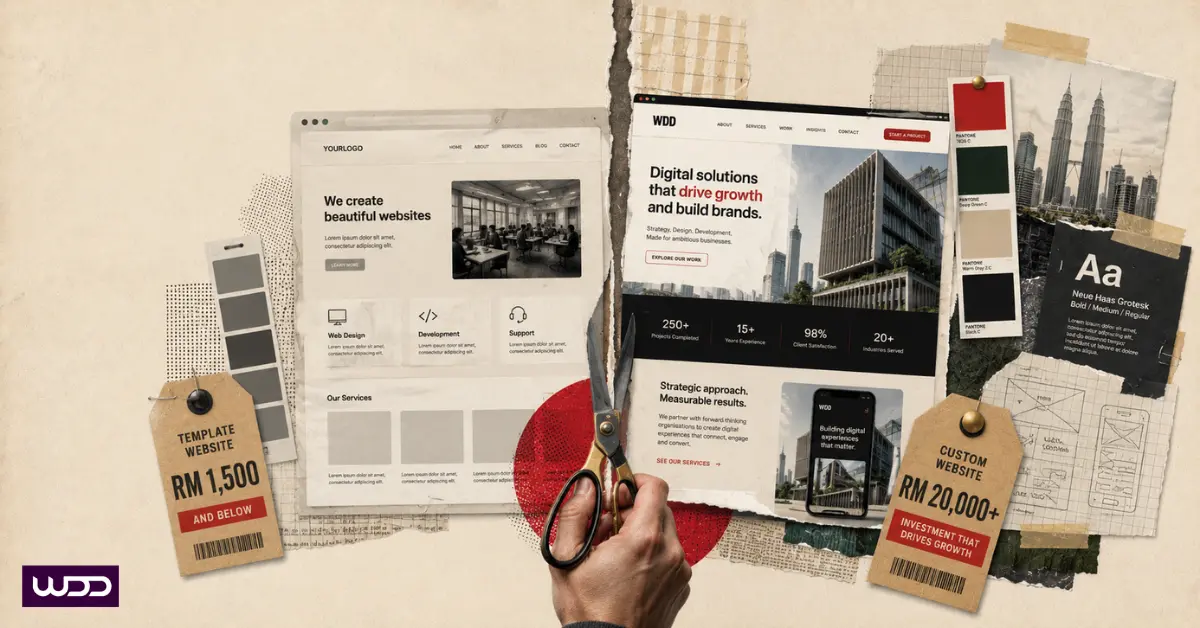
Most Malaysian businesses are really choosing between a template-based website and a custom-designed one. Price follows that decision, so it helps to be clear-eyed about which one your situation actually calls for, rather than defaulting to the cheaper option and regretting it. Our full guide to custom versus template websites walks through the five-year cost of each if you want to weigh the decision in more detail.
| Consideration | Template website | Custom website |
|---|---|---|
| Typical price | RM1,500 to RM6,000 | RM8,000 to RM120,000+ |
| Time to launch | Faster | Longer, planned |
| Differentiation | Limited, may resemble competitors | Unique to your brand |
| Scalability | Constrained as needs grow | Built to expand |
| Best for | Simple presence, early stage | Lead generation, credibility, growth |
We will say the unfashionable thing here: for a genuinely simple, short-term, or low-risk site, a template build or even a capable freelancer is the sensible spend, and paying agency rates for it is a waste of your money. The case for a custom build only holds when the website has a real job to do, generating enquiries, representing the brand to stakeholders, or carrying functionality a template cannot credibly support.
Template vs custom vs freelancer: pros and cons
Template website
RM1,500 to RM6,000- Lowest cost and fastest to launch
- Easy to manage without a developer
- Fine for simple, informational sites
- Limited differentiation from competitors
- Constrained as the business grows
- Weaker conversion and SEO ceiling
Custom website
RM8,000 to RM120,000+- Brand-led and built to convert
- Scales with integrations and features
- Stronger SEO and performance foundation
- Higher upfront investment
- Longer, planned timeline
- Overkill for a simple presence
Freelancer
RM1,500 to RM6,000+- Affordable for small, scoped builds
- Direct communication, no overhead
- Flexible for one-off projects
- Single point of dependency
- Continuity depends on availability
- Limited capacity for complex sites
What different Malaysian businesses should expect to pay
Sole proprietor or new startup, informational site
A clean three to five page site to establish presence and credibility. Expect RM1,500 to RM5,000. Spending RM20,000 here buys you nothing the business can use yet.
Growing Petaling Jaya SME chasing leads
A conversion-focused site with strong SEO foundations and lead capture. Expect RM8,000 to RM25,000. The build should pay for itself through enquiry quality within the first year.
If your buyers are searching for you in KL
Where your customers are matters as much as what you build. A Kuala Lumpur business competing against agencies one search result above it needs a site built for how the city actually searches, across districts, languages, and increasingly AI answers, not just a generic "Malaysia" page. If that's you, our web design KL page breaks down what a corporate build costs and delivers for the KL market specifically, from KLCC-grade credibility to bilingual Cheras and Bangsar audiences.
Multi-outlet F&B or retailer selling online
E-commerce, payment gateway, and inventory logic push this to RM12,000 to RM40,000+ depending on catalogue size and integrations. Cheap e-commerce almost always costs more in lost sales.
Selangor manufacturer or PLC needing investor-grade presence
Bespoke design, compliance, multi-audience content, and analytics. Expect RM30,000 to RM120,000+. At this level corporate website design is governance and reputation, not marketing decoration.
Short campaign or proof-of-concept landing page
A single focused page. A template or AI builder may be enough at RM800 to RM4,000. Only go custom if it must convert at scale or integrate with your systems.
Total cost of ownership: what a website really costs

The quoted build price is the start, not the total. The truer figure is the total cost of ownership across the site's useful life, and it changes the comparison between two quotes more than anything on the proposal.
Beyond the build: what ongoing ownership costs
The quote covers the build. These are the running costs that keep a website live, secure, and growing. Budget for them from day one, because skipping them is how a working site quietly decays into a rebuild.
Domain
RM60 to RM120 / yearYour web address. A .com.my or .my renews annually and is rarely bundled into the design price.
Hosting
RM600 to RM3,000 / yearWhere the site lives. Shared hosting suits small sites; VPS or cloud for heavier traffic and speed.
SSL certificate
Free to RM500 / yearThe padlock and https. Basic SSL is often free; business or wildcard certificates cost more.
Maintenance
Recurring monthlyUpdates, backups, security, and edits. See our website maintenance plans for what each tier covers.
Content
RM80 to RM1,800 / pageCopywriting, images, and updates as the business evolves. Good content is what makes a site earn.
SEO to grow
RM1,000 to RM10,000+ / monthOptional, but this is how a site climbs and pulls in enquiries rather than just sitting online.
A built website is not the finish line. Planned website maintenance keeps it secure and fast, and if you want it to actively grow traffic and leads, that is where SEO comes in. Our SEO services cover the strategy behind ranking, and if you are a Petaling Jaya business chasing local visibility, check out SEO Petaling Jaya for geo-focused help.
Most business sites run for three to five years. Higher upfront investment in a scalable build usually means fewer major changes across that span, which is why the cheaper launch so often becomes the dearer decision.
You may not need to pay it all upfront
For SMEs where the right website is a stretch on cash flow, the cost does not have to come out of one month's budget. Bank Negara Malaysia channels concessional financing to SMEs through participating banks under its Fund for SMEs, and the most relevant one here is the Automation and Digitalisation Facility, set up specifically to help SMEs digitalise operations and improve productivity.
Financing is offered at concessional rates through commercial banks, Islamic banks, and development financial institutions, with guarantee coverage for businesses that lack collateral. A RM15,000 to RM30,000 custom build becomes a manageable monthly commitment rather than a lump sum. Check eligibility and current facilities on the Fund for SMEs page before assuming a serious website is out of reach.
Freelance web designer vs agency: the real price difference
The same website costs differently depending on who builds it, and both options exist for good reasons. The right choice is about complexity and business impact, not the lowest hourly rate.
| Factor | Freelancer | Agency |
|---|---|---|
| Typical price | RM80 to RM300/hr or RM1,500 to RM6,000+ | RM8,000 to RM120,000+ |
| Capacity | One person | Design, dev, content, PM team |
| Continuity | Depends on availability | Structured, ongoing support |
| Best for | Small, clearly scoped builds | Strategic, growth, integration-heavy sites |
In fairness to freelancers: for a tight, well-defined project with little ongoing complexity, a good freelancer offers excellent value and direct communication, and an agency's process can feel like overkill.
The agency premium earns its place when scope, risk, accountability, and continuity matter, which is exactly when a single-person dependency becomes the expensive option. We weigh this trade-off in full in our web design agency vs freelancer guide, with eight scenarios and a five-question decision framework.
AI website builders vs professional web design
AI website builders are genuinely capable in 2026, and for the right job they are the sensible, low-cost answer. They generate layouts quickly, handle simple informational sites, and produce placeholder copy and visuals at near-zero cost. For a very small business, a temporary campaign, or a proof of concept, they are a sensible starting point and we would not talk you out of one.
What they cannot price in is judgement. AI tools do not understand your market, competitive position, or local nuances well enough to build meaningful differentiation. They do not handle custom business logic, lead qualification, booking rules, or system integrations.
They do not own performance, security, SEO continuity, or scalability after launch, and they do not optimise based on how real users behave. When a website has to generate revenue, represent a brand credibly, or integrate with your operations, professional web design is not an upsell, it is the difference between an asset and a placeholder.
How to judge whether a web design price is fair

A fair quote is one where the price matches the job the website has to do, and where you can see what you are paying for. Before comparing figures, get clear on intent: is this site informational, or is it expected to generate enquiries, sales, or stakeholder trust? That single answer moves the sensible budget more than any line item.
Then look past the headline number. Ask what is included after launch, who is responsible when something breaks, whether the build is scalable, and what the total cost looks like across three years rather than on day one.
The most cost-effective website in 2026 is rarely the cheapest to launch. It is the one that performs reliably, adapts to change, and keeps earning its keep. For a deeper view of how a site is built to do that, our website design services page sets out the approach in full.
Web design price in Malaysia: frequently asked questions
How much should I budget for a professional business website in Malaysia in 2026?
For most Malaysian SMEs, a realistic budget for a credible, lead-ready website starts around RM8,000 and commonly runs to RM25,000, depending on page count, functionality, and integrations. Simple informational sites can be done well from RM1,500 to RM6,000, while corporate or enterprise platforms run RM30,000 to RM120,000 or more.
Why do web design prices in Malaysia vary so much?
Price tracks design complexity, number of pages, functionality, integrations, performance and security requirements, and long-term scalability. A site built only to look presentable costs far less than one built to generate enquiries, integrate with systems, and last five years without a rebuild.
Is a template website enough for a growing business?
For early-stage or purely informational needs, yes, and it is the smart spend. As the business grows and the website is expected to drive leads, differentiate the brand, or carry functionality, template limits in scalability and conversion usually surface, and many businesses then move to a custom build.
What ongoing costs come after the website goes live?
Expect hosting, domain, SSL, security, updates, monitoring, and minor content changes. Ongoing website maintenance is a recurring monthly cost that depends on the site's size and role; our website maintenance plans guide sets out what each tier covers. These costs prevent the larger expenses that neglect eventually forces.
How much does an e-commerce website cost in Malaysia?
E-commerce sites generally start around RM4,000 and rise with catalogue size, payment gateway, and inventory or logistics integrations. Most serious online stores land between RM12,000 and RM40,000+. Payment gateways such as iPay88 or e-GHL add roughly RM300+ per year.
Should I hire a freelancer or an agency?
Choose based on complexity and business impact, not price alone. Freelancers suit small, clearly scoped builds and offer direct, affordable delivery. Agencies suit websites that play a strategic role and need a team, structured process, accountability, and continuity beyond launch.
How long should a professionally designed website last before a redesign?
A well-planned and maintained website typically lasts three to five years before a major redesign. Sites built with scalability and performance in mind can last longer, needing incremental improvements rather than full replacement.
Does web design cost more in Kuala Lumpur?
Not inherently, the price tracks scope, not postcode. But KL's market is more competitive and more image-conscious, so the sites that succeed there are usually built to a higher standard of speed, credibility, and bilingual reach. We cover what that means for web design in Kuala Lumpur on our dedicated page.
Choosing the right website investment
Custom Web Design
A brand-led, conversion-focused build for businesses where the website has a real job to do.
Explore website designTemplate Web Design
A faster, lower-cost route to a clean, credible presence when the brief is genuinely simple.
See template optionsSEO Services
A great website only pays off when people find it. Pair the build with SEO so the site earns traffic and enquiries, not just sits online.
Explore Google SEO Malaysia servicesStill unsure which band your project sits in? The most useful next step is a straight conversation about scope and fit, with no pressure to spend more than the job needs.
Request a quotation