A Selangor manufacturer paid RM25,000 for a custom website a RM3,500 template could have matched for three years.
Custom is not automatically better, and a template is not automatically cheaper once you count years of ownership. This guide compares custom website design Malaysia against template builds on SEO ceilings, ownership and risk, so you choose the approach your business stage needs, not the better sales pitch.
After years of building, rescuing and maintaining Malaysian business websites, our position is simple: match the build to the job and you will not overspend. A professionally implemented template at RM1,500 to RM6,000 is the best value for money for brochure and lead-generation websites, live in 2 to 4 weeks, and it is what we recommend to most SMEs. A custom build, from RM8,000 into the tens of thousands, is the right call, and worth every ringgit, when the website is a core revenue channel, needs functionality no theme provides, or must satisfy corporate governance.
Prestige is not a reason to go custom. The upfront quote alone is not a reason to go template. Value comes from fit, and fit is exactly what this guide teaches you to judge.
'%2F%3E%3Crect%20x%3D'90'%20y%3D'250'%20width%3D'76'%20height%3D'7'%20rx%3D'3.5'%20fill%3D'%23ff4d8d'%2F%3E%3Ctext%20x%3D'88'%20y%3D'320'%20font-family%3D'Georgia%2C%22Times%20New%20Roman%22%2Cserif'%20font-size%3D'60'%20fill%3D'%23ffffff'%20font-weight%3D'700'%3ECustom%20vs%20Template%3C%2Ftext%3E%3Ctext%20x%3D'90'%20y%3D'372'%20font-family%3D'Arial%2Csans-serif'%20font-size%3D'26'%20fill%3D'rgba(255%2C255%2C255%2C0.78)'%3EThe%202026%20build%20approach%20decision%3C%2Ftext%3E%3Cg%20fill%3D'none'%20stroke%3D'%23ff6aa0'%20stroke-width%3D'4'%20stroke-linecap%3D'round'%20stroke-linejoin%3D'round'%3E%3Crect%20x%3D'864'%20y%3D'214'%20width%3D'108'%20height%3D'200'%20rx%3D'12'%2F%3E%3Cpath%20d%3D'M886%20214v200'%2F%3E%3Ccircle%20cx%3D'875'%20cy%3D'230'%20r%3D'3.5'%2F%3E%3Cpath%20d%3D'M900%20250h56M900%20280h44M900%20310h56M900%20340h38'%2F%3E%3Crect%20x%3D'992'%20y%3D'214'%20width%3D'112'%20height%3D'200'%20rx%3D'12'%2F%3E%3Cpath%20d%3D'M1048%20214v200M992%20314h112'%2F%3E%3C%2Fg%3E%3C%2Fsvg%3E)
'%2F%3E%3Crect%20x%3D'90'%20y%3D'250'%20width%3D'76'%20height%3D'7'%20rx%3D'3.5'%20fill%3D'%23ff4d8d'%2F%3E%3Ctext%20x%3D'88'%20y%3D'320'%20font-family%3D'Georgia%2C%22Times%20New%20Roman%22%2Cserif'%20font-size%3D'60'%20fill%3D'%23ffffff'%20font-weight%3D'700'%3ETwo%20Build%20Approaches%3C%2Ftext%3E%3Ctext%20x%3D'90'%20y%3D'372'%20font-family%3D'Arial%2Csans-serif'%20font-size%3D'26'%20fill%3D'rgba(255%2C255%2C255%2C0.78)'%3ETheme%20implementation%20vs%20blank%20artboard%3C%2Ftext%3E%3Cg%20fill%3D'none'%20stroke%3D'%23ff6aa0'%20stroke-width%3D'4'%20stroke-linecap%3D'round'%20stroke-linejoin%3D'round'%3E%3Cpath%20d%3D'M984%20214l96%2050-96%2050-96-50z'%2F%3E%3Cpath%20d%3D'M888%20300l96%2050%2096-50'%2F%3E%3Cpath%20d%3D'M888%20350l96%2050%2096-50'%2F%3E%3C%2Fg%3E%3C%2Fsvg%3E)
What custom and template actually mean
A template website adapts a pre-built theme to your brand and launches in weeks; a custom website is designed and built from scratch to your exact requirement, at several times the budget. The right choice depends on what the site must do, not which sounds better.
Your designer adapts colours, type, imagery and content to your brand, arranges pre-built sections into your pages, and launches on a platform like WordPress. You are buying implementation and content work, not original design. Done well it looks credible; done cheaply it looks like the demo with your logo swapped in.
Strategy and wireframes first, then original design, then development to that exact spec. Every layout decision and line of code exists because your requirement called for it. That is where the cost goes: discovery, design revisions, bespoke development and a proper testing cycle.
Between them sits a grey zone: heavily customised templates. A skilled team can push a good theme well beyond its demo at a fraction of custom cost. Reputable website design services in Malaysia offer both routes, and an honest proposal tells you which your requirement needs, not which carries the better margin.
'%2F%3E%3Crect%20x%3D'90'%20y%3D'250'%20width%3D'76'%20height%3D'7'%20rx%3D'3.5'%20fill%3D'%23ff4d8d'%2F%3E%3Ctext%20x%3D'88'%20y%3D'320'%20font-family%3D'Georgia%2C%22Times%20New%20Roman%22%2Cserif'%20font-size%3D'60'%20fill%3D'%23ffffff'%20font-weight%3D'700'%3ECost%20Tiers%202026%3C%2Ftext%3E%3Ctext%20x%3D'90'%20y%3D'372'%20font-family%3D'Arial%2Csans-serif'%20font-size%3D'26'%20fill%3D'rgba(255%2C255%2C255%2C0.78)'%3ETemplate%20to%20corporate%20custom%3C%2Ftext%3E%3Cg%20fill%3D'none'%20stroke%3D'%23ff6aa0'%20stroke-width%3D'4'%20stroke-linecap%3D'round'%20stroke-linejoin%3D'round'%3E%3Crect%20x%3D'872'%20y%3D'330'%20width%3D'52'%20height%3D'84'%20rx%3D'7'%2F%3E%3Crect%20x%3D'950'%20y%3D'286'%20width%3D'52'%20height%3D'128'%20rx%3D'7'%2F%3E%3Crect%20x%3D'1028'%20y%3D'238'%20width%3D'52'%20height%3D'176'%20rx%3D'7'%2F%3E%3Ccircle%20cx%3D'1066'%20cy%3D'214'%20r%3D'30'%2F%3E%3Cpath%20d%3D'M1066%20200v28M1058%20208h11a5%205%200%200%201%200%2010h-9a5%205%200%200%200%200%2010h12'%2F%3E%3C%2Fg%3E%3C%2Fsvg%3E)
What custom website design Malaysia projects cost in 2026
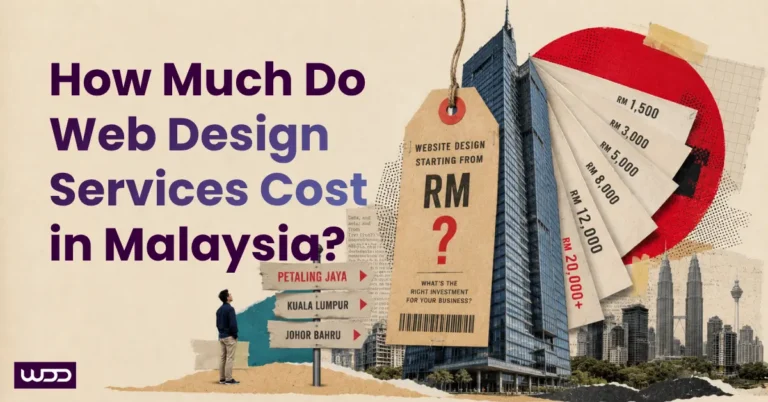
Malaysian pricing splits into three tiers. These bands are here only to frame the build-approach decision, not to price your project; for the full cost breakdown, hidden line items and quote checklist, our web design price Malaysia guide is the authority. Ecommerce scales higher.
- Professional theme, adapted to brand
- 5 to 12 pages, standard forms and WhatsApp CTA
- On-page SEO basics and mobile responsiveness
- Original design from wireframes
- Conversion-planned page structure
- Custom sections, calculators or catalogue logic
- Discovery, stakeholder workshops, governance
- Multi-language, integrations, investor sections
- Formal QA, accessibility and security review
- Template stores launch fast on Shopify or WooCommerce
- Custom pays once catalogue or stock logic gets complex
- Store pricing sits in the price guide
Two warnings. The cheapest custom quote is often a template in disguise: no wireframe stage means you are paying custom rates for template work. And the quote is not the cost, hosting, licences, content and maintenance sit outside most proposals.
'%2F%3E%3Crect%20x%3D'90'%20y%3D'250'%20width%3D'76'%20height%3D'7'%20rx%3D'3.5'%20fill%3D'%23ff4d8d'%2F%3E%3Ctext%20x%3D'88'%20y%3D'320'%20font-family%3D'Georgia%2C%22Times%20New%20Roman%22%2Cserif'%20font-size%3D'60'%20fill%3D'%23ffffff'%20font-weight%3D'700'%3ESide%20by%20Side%3C%2Ftext%3E%3Ctext%20x%3D'90'%20y%3D'372'%20font-family%3D'Arial%2Csans-serif'%20font-size%3D'26'%20fill%3D'rgba(255%2C255%2C255%2C0.78)'%3ETen%20factors%20that%20decide%20the%20build%3C%2Ftext%3E%3Cg%20fill%3D'none'%20stroke%3D'%23ff6aa0'%20stroke-width%3D'4'%20stroke-linecap%3D'round'%20stroke-linejoin%3D'round'%3E%3Cpath%20d%3D'M984%20210v208M916%20418h136'%2F%3E%3Cpath%20d%3D'M984%20232l-104%2034m104-34l104%2034'%2F%3E%3Cpath%20d%3D'M880%20266l-38%2076a42%2026%200%200%200%2076%200z'%2F%3E%3Cpath%20d%3D'M1088%20266l-38%2076a42%2026%200%200%200%2076%200z'%2F%3E%3Ccircle%20cx%3D'984'%20cy%3D'210'%20r%3D'8'%2F%3E%3C%2Fg%3E%3C%2Fsvg%3E)
Custom vs template: the full comparison
The whole decision in one table. Read the SEO ceiling and scalability rows twice; that is where the five-year consequences hide.
| Factor | Template website | Custom build |
|---|---|---|
| Upfront cost | RM1,500 to RM6,000 | RM8,000 to RM120,000+ |
| Timeline | 2 to 4 weeks | 6 to 20 weeks |
| Design uniqueness | Shared foundation, brand-adapted | Original, built to your positioning |
| SEO ceiling | Solid for local terms, capped by theme code | Full control over structure and markup |
| Speed control | Limited; theme bloat is common | Every asset is a choice you make |
| Functionality | Drag-and-drop editors and plugins, within preset limits | Built to requirement, editors and integrations included |
| Content editing | Familiar builder tools, easy handover | Depends on how the CMS is set up |
| Ownership | Yours on WordPress; rented on builders | Fully yours, code included |
| Scalability | Fine until traffic and features outgrow the theme; unused code can drag speed as you scale | Grows with the business plan; only the features you use ship |
| Best fit | Brochure and lead-gen sites, first websites | Revenue-critical sites, corporates, unique needs |
Red flags to catch in any quotation
The quotation itself tells you a lot about the vendor. Tick the ones you have seen in a quote you are holding, the tally tells you how exposed you are.
'%2F%3E%3Crect%20x%3D'90'%20y%3D'250'%20width%3D'76'%20height%3D'7'%20rx%3D'3.5'%20fill%3D'%23ff4d8d'%2F%3E%3Ctext%20x%3D'88'%20y%3D'320'%20font-family%3D'Georgia%2C%22Times%20New%20Roman%22%2Cserif'%20font-size%3D'60'%20fill%3D'%23ffffff'%20font-weight%3D'700'%3EThe%20SEO%20Ceiling%3C%2Ftext%3E%3Ctext%20x%3D'90'%20y%3D'372'%20font-family%3D'Arial%2Csans-serif'%20font-size%3D'26'%20fill%3D'rgba(255%2C255%2C255%2C0.78)'%3ECore%20Web%20Vitals%20and%20code%20control%3C%2Ftext%3E%3Cg%20fill%3D'none'%20stroke%3D'%23ff6aa0'%20stroke-width%3D'4'%20stroke-linecap%3D'round'%20stroke-linejoin%3D'round'%3E%3Cpath%20d%3D'M872%20350h224'%20stroke-dasharray%3D'12%2010'%2F%3E%3Cpath%20d%3D'M888%20400l58%20-58%2034%2034%2074%20-86'%2F%3E%3Cpath%20d%3D'M1028%20290h28v28'%2F%3E%3Cpath%20d%3D'M888%20400v14M946%20342v72M980%20376v38M1054%20290v124'%2F%3E%3C%2Fg%3E%3C%2Fsvg%3E)
SEO ceiling, speed and performance
Kill the myth first: templates are not bad for SEO. For most local Malaysian keywords, rankings turn on content quality, internal linking, backlinks and intent match. A well-implemented template on decent hosting will outrank a poorly executed custom site every time.
Typical template
Commercial theme, shared code, plugin stack
Lean custom build
Only the code the page needs, controlled markup
Illustrative headroom, not a guaranteed score. A disciplined template still beats a bloated custom build; only the ceiling differs.
What templates carry is a ceiling. Commercial themes ship code for every feature any buyer might want, so your site loads scripts and styles it never uses. That bloat drags on Core Web Vitals, and past a certain point no caching plugin can fully rescue it. You also inherit the theme's markup decisions, which limits how precisely you can structure content for featured snippets and AI-generated answers.
A custom website design Malaysia project removes that ceiling: your developer controls every kilobyte, heading and schema block. On competitive terms where the top five results are all professionally optimised, that control is often the remaining edge. On a local page where half the competitors have not updated since 2022, it is expensive overkill.
Practical test: search your three most valuable keywords. If page one is full of fast, well-built competitors, performance control has real value. If not, spend the difference on content and links.
If organic search drives your leads, the build is only half the story; the other half is SEO services in Malaysia and whether AI assistants cite you. Do not assume a rebuild alone lifts rankings.
'%2F%3E%3Crect%20x%3D'90'%20y%3D'250'%20width%3D'76'%20height%3D'7'%20rx%3D'3.5'%20fill%3D'%23ff4d8d'%2F%3E%3Ctext%20x%3D'88'%20y%3D'320'%20font-family%3D'Georgia%2C%22Times%20New%20Roman%22%2Cserif'%20font-size%3D'60'%20fill%3D'%23ffffff'%20font-weight%3D'700'%3EThe%20Five-Year%20Cost%3C%2Ftext%3E%3Ctext%20x%3D'90'%20y%3D'372'%20font-family%3D'Arial%2Csans-serif'%20font-size%3D'26'%20fill%3D'rgba(255%2C255%2C255%2C0.78)'%3EOwnership%2C%20upkeep%20and%20real%20totals%3C%2Ftext%3E%3Cg%20fill%3D'none'%20stroke%3D'%23ff6aa0'%20stroke-width%3D'4'%20stroke-linecap%3D'round'%20stroke-linejoin%3D'round'%3E%3Ccircle%20cx%3D'912'%20cy%3D'316'%20r%3D'46'%2F%3E%3Ccircle%20cx%3D'912'%20cy%3D'316'%20r%3D'17'%2F%3E%3Cpath%20d%3D'M948%20282l108-108m-30%2030%2026%2026m-56%204%2026%2026'%2F%3E%3Cpath%20d%3D'M1064%20316a80%2080%200%201%201-30-62'%20stroke-dasharray%3D'9%2011'%2F%3E%3C%2Fg%3E%3C%2Fsvg%3E)
Ownership and the five-year cost
The upfront quote is the loudest number and the least complete. Run the maths over five years and the gap changes shape.
The upfront build is only the visible half. A template and a custom build can start thousands apart, but the gap that matters is whether the pricier build returns more than its premium over the years you run it. For many SMEs a good template is enough; when the website is the primary sales channel, custom usually repays the difference. The full cost picture, running costs included, lives in our web design price Malaysia guide.
A RM16,000 build gap. Running costs, hosting, domain and maintenance, apply to both and are broken down in full on the price guide. The decision is not the cheaper build, but the one whose job justifies it.
There is a second cost the invoice never shows: constraint cost, what becomes harder to change and scale as the business grows. Build cost is paid once and visible; constraint cost is paid in instalments for years and appears nowhere on the quote. The cheaper build can carry the heavier constraint.
Ownership is the other half of the ledger. A WordPress template on your own hosting is fully yours: files, database, domain. A site on a subscription builder is rented, and disappears the month you stop paying. A custom build is yours down to the code, but that makes you responsible for it: no theme vendor ships free updates, so someone must patch, test and secure it, which is why serious builds are paired with a care plan, from around RM450 a month, set out in our website maintenance services Malaysia.
What we see in rescue projects
A pattern from our maintenance work: the priciest sites we fix are rarely cheap templates. They are mid-priced "custom" builds shipped without documentation, where every change needs the original vendor, long since moved on. Owned on paper, untouchable. A custom build is only as portable as its documentation, so make handover a written deliverable.
Whichever route you take, get this in writing before paying a deposit: who owns the design files, who owns the code, and what it costs to take everything elsewhere.
'%2F%3E%3Crect%20x%3D'90'%20y%3D'250'%20width%3D'76'%20height%3D'7'%20rx%3D'3.5'%20fill%3D'%23ff4d8d'%2F%3E%3Ctext%20x%3D'88'%20y%3D'320'%20font-family%3D'Georgia%2C%22Times%20New%20Roman%22%2Cserif'%20font-size%3D'60'%20fill%3D'%23ffffff'%20font-weight%3D'700'%3EWhen%20Template%20Wins%3C%2Ftext%3E%3Ctext%20x%3D'90'%20y%3D'372'%20font-family%3D'Arial%2Csans-serif'%20font-size%3D'26'%20fill%3D'rgba(255%2C255%2C255%2C0.78)'%3EFive%20situations%20where%20cheaper%20is%20right%3C%2Ftext%3E%3Cg%20fill%3D'none'%20stroke%3D'%23ff6aa0'%20stroke-width%3D'4'%20stroke-linecap%3D'round'%20stroke-linejoin%3D'round'%3E%3Cpath%20d%3D'M984%20208c44%2030%2060%2090%2060%20146l24%2046-46-16a94%2094%200%200%201-78%200l-46%2016%2024-46c0-56%2016-116%2060-146z'%2F%3E%3Ccircle%20cx%3D'984'%20cy%3D'298'%20r%3D'20'%2F%3E%3Cpath%20d%3D'M948%20400c-11%2011-13%2030-13%2030s19-2%2030-13M1020%20400c11%2011%2013%2030%2013%2030s-19-2-30-13'%2F%3E%3C%2Fg%3E%3C%2Fsvg%3E)
When a template is the smarter choice
Full disclosure: agencies, ours included, earn better margins on custom. That is exactly why you should be sceptical when custom is the first recommendation, and why this section exists.
A template is the smarter choice when any of these is true. Tap each to see why:
Services, proof, contact, WhatsApp. Themes solved this layout long ago, and a well-implemented one converts as well as a bespoke build for this brief.
Covered in weeks, not months.
You are testing a new business or market and cannot wait months to appear online.
Speed beats polish while proving demand.
A cheap custom build is worse than a good template every time, thin design, thin testing, high risk.
Spend it on content a template carries perfectly.
When rivals have not updated since 2022, content quality alone out-positions them.
You win on substance, not custom code.
If no one in the company will run bespoke functionality after launch, it becomes dead weight.
Fewer moving parts, easier upkeep.
Paying custom website design Malaysia rates to reproduce what a good theme already does is waste; the money is better spent on photography, copywriting and SEO content a template carries perfectly well. If your requirement is simpler still, a DIY platform can do for a season; our website builder Malaysia comparison covers where those tools genuinely work and where their ownership and SEO limits start to cost you.
Template does not mean careless. The corners most often cut are image optimisation, mobile checks below 400px, and deleting demo content that stays indexed. A template built with discipline is a real business asset; one built in an afternoon is why the approach has a bad name.
'%2F%3E%3Crect%20x%3D'90'%20y%3D'250'%20width%3D'76'%20height%3D'7'%20rx%3D'3.5'%20fill%3D'%23ff4d8d'%2F%3E%3Ctext%20x%3D'88'%20y%3D'320'%20font-family%3D'Georgia%2C%22Times%20New%20Roman%22%2Cserif'%20font-size%3D'60'%20fill%3D'%23ffffff'%20font-weight%3D'700'%3EWhen%20Custom%20Pays%3C%2Ftext%3E%3Ctext%20x%3D'90'%20y%3D'372'%20font-family%3D'Arial%2Csans-serif'%20font-size%3D'26'%20fill%3D'rgba(255%2C255%2C255%2C0.78)'%3EFive%20triggers%20that%20justify%20the%20price%3C%2Ftext%3E%3Cg%20fill%3D'none'%20stroke%3D'%23ff6aa0'%20stroke-width%3D'4'%20stroke-linecap%3D'round'%20stroke-linejoin%3D'round'%3E%3Cpath%20d%3D'M984%20206l42%20118-42%2032-42-32z'%2F%3E%3Cpath%20d%3D'M984%20356v46'%2F%3E%3Ccircle%20cx%3D'984'%20cy%3D'288'%20r%3D'13'%2F%3E%3Cpath%20d%3D'M880%20406a108%20108%200%200%201%20208%200'%20stroke-dasharray%3D'9%2011'%2F%3E%3C%2Fg%3E%3C%2Fsvg%3E)
When custom pays for itself
Custom becomes the correct engineering decision when any of these is true. Tap each to see why:
When a one percent conversion improvement is worth five figures a year, conversion-planned custom design pays back quickly.
Conversion lift compounds on a revenue site.
Dealer locators, quote configurators, member portals, ERP or CRM integrations. Bending plugins into this costs more long term than building it properly.
Purpose-built beats plugin duct tape.
If you sell premium and look like three competitors, the template contradicts your pricing.
Distinct design defends a premium price.
PLCs, GLCs and regulated industries need accessibility, security review and stakeholder sign-off theme licences were never designed for.
Carries the audit trail procurement needs.
The third rebuild is the one to do properly, on foundations that scale.
Build it right once, end the cycle.
One condition sits above all five: custom projects are only as good as the team running them. A build from an inexperienced vendor pairs the highest price with the highest risk, so vet who builds it as carefully as what gets built; our Malaysia web designer hiring guide covers that decision in full. A custom web design in Malaysia taking on custom work should show you discovery documents, wireframes and QA checklists from past projects before asking for yours.
For businesses whose website carries lead generation or stakeholder credibility, our custom website design services are scoped for exactly that brief.
'%2F%3E%3Crect%20x%3D'90'%20y%3D'250'%20width%3D'76'%20height%3D'7'%20rx%3D'3.5'%20fill%3D'%23ff4d8d'%2F%3E%3Ctext%20x%3D'88'%20y%3D'320'%20font-family%3D'Georgia%2C%22Times%20New%20Roman%22%2Cserif'%20font-size%3D'60'%20fill%3D'%23ffffff'%20font-weight%3D'700'%3EFour%20MY%20Scenarios%3C%2Ftext%3E%3Ctext%20x%3D'90'%20y%3D'372'%20font-family%3D'Arial%2Csans-serif'%20font-size%3D'26'%20fill%3D'rgba(255%2C255%2C255%2C0.78)'%3ESame%20question%2C%20four%20verdicts%3C%2Ftext%3E%3Cg%20fill%3D'none'%20stroke%3D'%23ff6aa0'%20stroke-width%3D'4'%20stroke-linecap%3D'round'%20stroke-linejoin%3D'round'%3E%3Crect%20x%3D'872'%20y%3D'214'%20width%3D'104'%20height%3D'92'%20rx%3D'11'%2F%3E%3Crect%20x%3D'992'%20y%3D'214'%20width%3D'104'%20height%3D'92'%20rx%3D'11'%2F%3E%3Crect%20x%3D'872'%20y%3D'322'%20width%3D'104'%20height%3D'92'%20rx%3D'11'%2F%3E%3Crect%20x%3D'992'%20y%3D'322'%20width%3D'104'%20height%3D'92'%20rx%3D'11'%2F%3E%3Ccircle%20cx%3D'924'%20cy%3D'260'%20r%3D'18'%2F%3E%3Cpath%20d%3D'M1028%20260h40M1048%20240v40'%2F%3E%3Cpath%20d%3D'M900%20368h48'%2F%3E%3Cpath%20d%3D'M1024%20368l16%2016%2032-36'%2F%3E%3C%2Fg%3E%3C%2Fsvg%3E)
Four Malaysian scenarios, four different answers
Same question, different businesses, different verdicts. Find yours below.
Early-stage PJ consultancy
Two partners, services and credibility site, budget RM5,000, needs to launch before a pitch season. No unusual functionality.
Verdict: TemplateMulti-outlet F&B group
Six outlets, online ordering, loyalty integration and outlet-level menus. The website takes money daily and downtime is lost revenue.
Verdict: CustomSelangor manufacturer
Export-focused, needs a structured product catalogue and RFQ flow. Budget exists but requirements are still being proven with buyers.
Verdict: Hybrid, template firstPLC corporate site
Investor relations, Bursa announcements, bilingual content, brand governance and board sign-off. Procurement requires formal QA.
Verdict: CustomThe hybrid verdict is the market's most under-recommended path: launch on a solid template, measure which pages earn enquiries for a year, then commission a custom build around proven demand with a proper 301 redirect map. You spend custom money on evidence, not guesses.
'%2F%3E%3Crect%20x%3D'90'%20y%3D'250'%20width%3D'76'%20height%3D'7'%20rx%3D'3.5'%20fill%3D'%23ff4d8d'%2F%3E%3Ctext%20x%3D'88'%20y%3D'320'%20font-family%3D'Georgia%2C%22Times%20New%20Roman%22%2Cserif'%20font-size%3D'60'%20fill%3D'%23ffffff'%20font-weight%3D'700'%3EBuild%20Fit%20Selector%3C%2Ftext%3E%3Ctext%20x%3D'90'%20y%3D'372'%20font-family%3D'Arial%2Csans-serif'%20font-size%3D'26'%20fill%3D'rgba(255%2C255%2C255%2C0.78)'%3EFive%20questions%2C%20one%20honest%20answer%3C%2Ftext%3E%3Cg%20fill%3D'none'%20stroke%3D'%23ff6aa0'%20stroke-width%3D'4'%20stroke-linecap%3D'round'%20stroke-linejoin%3D'round'%3E%3Crect%20x%3D'864'%20y%3D'226'%20width%3D'104'%20height%3D'44'%20rx%3D'22'%2F%3E%3Crect%20x%3D'864'%20y%3D'292'%20width%3D'104'%20height%3D'44'%20rx%3D'22'%2F%3E%3Crect%20x%3D'864'%20y%3D'358'%20width%3D'104'%20height%3D'44'%20rx%3D'22'%2F%3E%3Cpath%20d%3D'M968%20248h44l28%2066h24M968%20314h72M968%20380h44l28-66'%2F%3E%3Ccircle%20cx%3D'1064'%20cy%3D'314'%20r%3D'38'%2F%3E%3Cpath%20d%3D'M1048%20314l12%2012%2022-26'%2F%3E%3C%2Fg%3E%3C%2Fsvg%3E)
Which build approach fits you?
Answer five questions for an honest starting recommendation, not a quotation.
1. Realistic launch budget?
2. What is the website's job?
3. What changes over the next three years?
4. Do you need SEO to win competitive keywords?
5. Who maintains the website after launch?
Choose the build, then choose it well
Custom Web Design
Original design and development scoped to your revenue plan, not a theme demo.
From RM1,500Template Web Design
Professionally implemented, brand-adapted and launched in weeks.
Sell onlineEcommerce Web Design
Online stores built for Malaysian payment, shipping and buying habits.
If you are still weighing the two, that is the correct instinct: it means you are matching the build to the business instead of the brochure. Compare the full corporate website design Malaysia scope on our service page, or request a quotation with your actual requirement and we will tell you honestly which tier it needs, even when the answer is the cheaper one.
Frequently asked questions
Web design in Malaysia costs RM1,500 to RM6,000 for a template site, RM8,000 to RM30,000 for a custom SME site, and RM30,000 to RM120,000 or more for corporate platforms. The gap funds original design, custom functionality and performance control, which only some businesses genuinely need. For the full breakdown by website type, see our web design price Malaysia guide.
No. A well-implemented template on good hosting, with proper structure and content, ranks. Templates carry a lower SEO ceiling because of shared code and less performance control, but for most local Malaysian keywords the content and internal linking matter far more than the build approach.
A template website typically launches in 2 to 4 weeks. An SME custom build takes 6 to 12 weeks, and corporate custom projects run 12 to 20 weeks including discovery, design approval and testing. In both routes, late content is the most common cause of delay.
Yes, and it is often the sensible sequence. Launch on a template, prove which pages generate enquiries, then reinvest in a custom build with a proper 301 redirect map so rankings carry over. Most of your content and SEO equity migrates with you.
It depends on the platform. A WordPress template site on your own hosting is yours: files, database and domain. A website built on a subscription builder is rented, and stops existing if you stop paying. Ownership is a platform question more than a template versus custom question.
For most small businesses under roughly RM2 million in annual revenue, a professionally implemented template at RM1,500 to RM6,000 is the better first website. Move to custom when the website becomes a core revenue channel or needs functionality that themes cannot deliver.